How to Find a Trustworthy Tailor in Victoria
Questions to ask, red flags to watch for, and how to tell a real tailor from a retail alteration counter in Victoria BC.
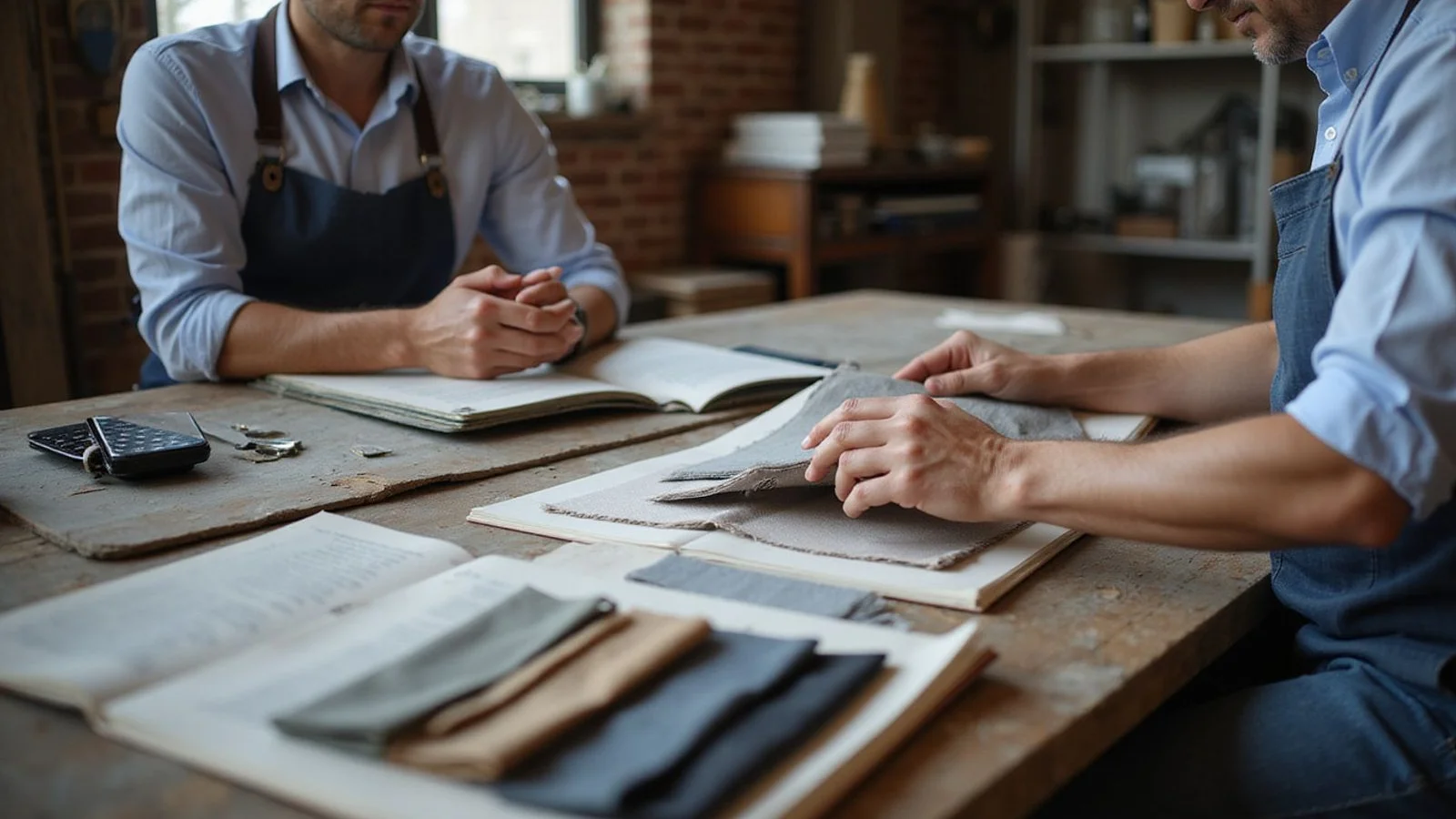
We frequently hear from clients who are frustrated by the search for genuine local craftsmanship.
Many shops hang a “tailor” sign in the window, but very few actually draft, cut, and sew their garments on-site. The gap between a true master craftsman and an overseas middleman is often hidden behind clever marketing.
Our team wants to share a few practical insights on how to choose a tailor victoria bc professionals can genuinely rely on. Finding the best tailor victoria bc has to offer means knowing how to spot authentic construction methods. The details in this guide will help you ask the right questions, identify warning signs, and recognize true quality before spending a single dollar. If your search is narrowed to bespoke specifically, the companion piece on how to choose a bespoke tailor drills deeper into the construction questions to ask.
How to choose a tailor victoria bc: The five questions to ask
Our recommended approach starts with a quick phone call before you even book a first appointment. A trustworthy tailor victoria locals respect will answer these five critical questions clearly in under two minutes. If a shop hesitates or gives vague responses, you should immediately take your business elsewhere.
We advise asking the following questions verbatim to get the most accurate read on a workshop’s capabilities. Getting direct answers upfront saves you from wasting time on a consultation that will not meet your needs. The first question is always about the location of the actual labor.
1. “Is every stage, including pattern drafting, cutting, and sewing, done on-site by you or your team?”
Our workshop, for example, handles all drafting, cutting, and construction right here on Fort Street. The answer you receive should be a direct yes with highly specific details about their facility. Vague answers or mentions of an overseas partner indicate a simple outsourcing operation.
2. “If I order a fully custom garment, is the pattern retained for future orders?”
We preserve every client’s unique measurements and paper patterns on file indefinitely to make future commissions effortless. A true master workshop follows this exact same retention practice. Starting over every single time means the shop is just measuring you for a standardized factory template.
3. “How many fittings are involved in a completely custom order?”
Our process never cuts corners on the crucial basted and final fitting stages. The answer you receive must be a minimum of two fittings. Three fittings are the absolute standard for a first-time client to ensure complete precision.
4. “How long is the turnaround time from the first fitting to final delivery?”
We want to warn you that timelines stretching past twelve weeks usually suggest an overseas factory queue. Six to eight weeks is the normal timeline for custom construction in Canada right now. A promised turnaround of less than four weeks is a massive red flag unless it involves a simple repeat order.
5. “If I bring in an alteration, do you tell clients when a garment is not worth fixing?”
Our policy is to offer honest advice, even if it means telling you to save your money. A confident professional will always answer yes to this question and truly mean it. Shops running strictly on volume tend to take every single job and send the work out to external contractors.
Red flags
We regularly see clients who have been burned by expensive shops masking poor quality. Spotting a few key warning signs early will protect your clothing budget. These common practices reveal when a business is more focused on sales than actual craftsmanship.
- No visible workshop. Our cutting table is visible the moment you walk through the door. If you cannot see the work area from the front of the shop, ask for a quick tour. A strict refusal is an immediate sign that nothing is actually made there.
- Work “sent out.” We know some alteration counters are entirely honest about being simple drop-off fronts for off-site operations. That setup is perfectly fine for a basic hem on a pair of jeans. For fully custom garments, sending work to a third party completely defeats the purpose.
- One fitting for a custom suit. We consider a single fitting to be nothing more than basic made-to-measure service. True custom clothing requires a basted fitting where the garment is temporarily stitched together. Skipping this step means the creator is guessing about your posture and body dynamics.
- Vague turnaround times. Our production schedules are precise because we control every step locally. Hearing a phrase like “a few weeks, maybe more” is highly concerning. This usually means the work is sitting in a massive queue at someone else’s factory.
- Pressure at the first appointment. We believe a consultation should feel like a collaborative conversation, not an aggressive sales pitch. A sudden deposit demand before you have even looked at cloth options is inappropriate. An aggressive up-sell on features you never asked for is another clear warning sign.
- Heavy discounting. We source premium British and Italian fabrics, and those materials carry a hard, non-negotiable cost floor. Hand-work hours and drafting time also establish a baseline price around the $3,000 mark for genuine quality. A promotion offering “60% off a $3,000 custom suit” is structurally impossible unless the garment was mass-produced to begin with.
How to judge sample work
We encourage every prospective client to pick up a finished jacket off the rack and inspect it closely. You do not need to be a textile expert to spot the difference between factory glue and hand-stitching. Looking at a few specific construction details will tell you exactly what you are paying for.
Our checklist below outlines the exact features to evaluate on any sample piece. Pay close attention to how the fabric drapes across the shoulders and neck. The smallest seams often reveal the highest levels of skill.
| Construction Detail | What to Look For | Why It Matters |
|---|---|---|
| Shoulder line | We verify that the shoulder seam sits perfectly clean against the body with absolutely no puckering under the collar. A clean shoulder indicates precise pattern drafting. | Careful hand-pressing during assembly is also required to achieve this look. |
| Collar gap | We construct collars to rest flush against the shirt entirely around the neck when buttoned on a dress form. Any visible gap at the back of the neck is a major drafting error. | This specific flaw completely ruins the entire silhouette of the jacket. |
| Lapel roll | We hand-roll every lapel so you see a soft, three-dimensional curve rolling from the collar down to the top button. A properly rolled lapel has natural life and volume. | Machine-pressed lapels always look flat and lifeless by comparison. |
| Stitch detail | We utilize delicate, slightly irregular hand pick-stitching along the lapel edge alongside perfectly clean machine work on the main body seams. Hand-stitching provides essential flexibility where the garment needs to move. | Clean machine seams offer the structural durability required for daily wear. |
We know these nuances can take time to recognize if you are new to custom clothing. If you do not quite trust your own eye yet, look at the fundamental client-facing details first. Reading a reliable guide on how a suit should actually fit is an excellent primer before your first shop visit.
What a proper consultation feels like
Our priority during a first meeting is simply to understand your lifestyle and specific wardrobe needs. A proper consultation is completely unrushed and takes place at a proper table, rather than a busy retail sales floor. The professional across from you will listen far more than they actually speak.
We ask questions that lean heavily toward the occasion, like what you are wearing the piece for and how often you travel. The conversation should naturally steer away from immediate up-sells like premium linings or extra buttons. You should always leave the building with a highly realistic quote, a firm timeline, and zero pressure to make a snap decision.
Our first consultation at Finch & Co. is thirty minutes long, entirely free, and completely pressure-free. Following this discussion, taking exact physical measurements only happens if you are completely ready to proceed. Having created over 1,000 garments locally, the experience should always feel reassuring and educational.
Why not Vancouver?
We often speak with clients who assume they must travel to the mainland to find world-class tailoring. A custom client heading to Vancouver makes a minimum of three round trips across the water for a consultation, a basted fitting, and a final fitting. That process consumes three full days of lost personal time.
Our calculations based on 2026 BC Ferries data show this commute is incredibly expensive. With standard vehicle fares sitting at $110 and adult passenger tickets at $21 each way, three round trips cost nearly $800 in ferry fees alone. This massive expense comes before you even factor in parking, meals, and the stress of threading a schedule around complex sailing timetables.
Our local workshop on Fort Street is comfortably supported by strong demand from the BC Legislature, the Courthouse, Oak Bay, and the thriving local wedding market. There is simply no practical reason to take the ferry when Savile Row-trained craftsmanship exists right in your neighborhood. Choosing a trusted local partner keeps your money in the community and guarantees a vastly superior fitting experience.
We hope this guide on how to choose a tailor victoria bc has given you the confidence to make an informed decision.
You can find detailed information on our custom suits, handmade custom shirts, and expert alterations. Reaching out today is the best way to start building a wardrobe that actually fits your life.
Common questions
How can I tell if a tailor's work is actually done on-site?
+
Ask to see the workshop. A real tailor welcomes the question and will walk you past the cutting table and the machines. An outsourcing operation will deflect — or claim the workshop is 'in the back' without ever showing it.
Should I bring a reference suit to a consultation?
+
Yes. A garment that fits well shows a tailor what your shoulders, posture, and preferred drape actually look like. A garment that fits badly shows them the specific problems you want to avoid. Either accelerates the conversation substantially.
Is Victoria too small to support a real bespoke tailor?
+
No. Demand from the government segment (BC Legislature, ministerial staff, lawyers), the wedding market, and long-standing Oak Bay and Uplands clients comfortably supports a dedicated on-site workshop.
More from this cluster
Caring for Your Custom-Tailored Garments
How to press, brush, rotate, and store a bespoke suit so it lasts ten years. Dry cleaning frequency, hanger choice, and stain handling.
InformationalHow a Suit Should Actually Fit: The 6 Points That Matter
The 6 fit points that determine whether a suit works: shoulder point, sleeve length, jacket length, trouser break, collar gap, waist suppression.
InformationalThe Savile Row Method: Training, Tools, and Why It Matters
What Savile Row training really involves, how it differs from made-to-measure, and why it changes how a bespoke suit is drafted in Victoria BC.
Questions beyond what's here?
Free thirty-minute consultations on Fort Street. We'll answer your specific questions and give you a realistic quote.