How a Suit Should Actually Fit
The 6 fit points that determine whether a suit works: shoulder point, sleeve length, jacket length, trouser break, collar gap, waist suppression.
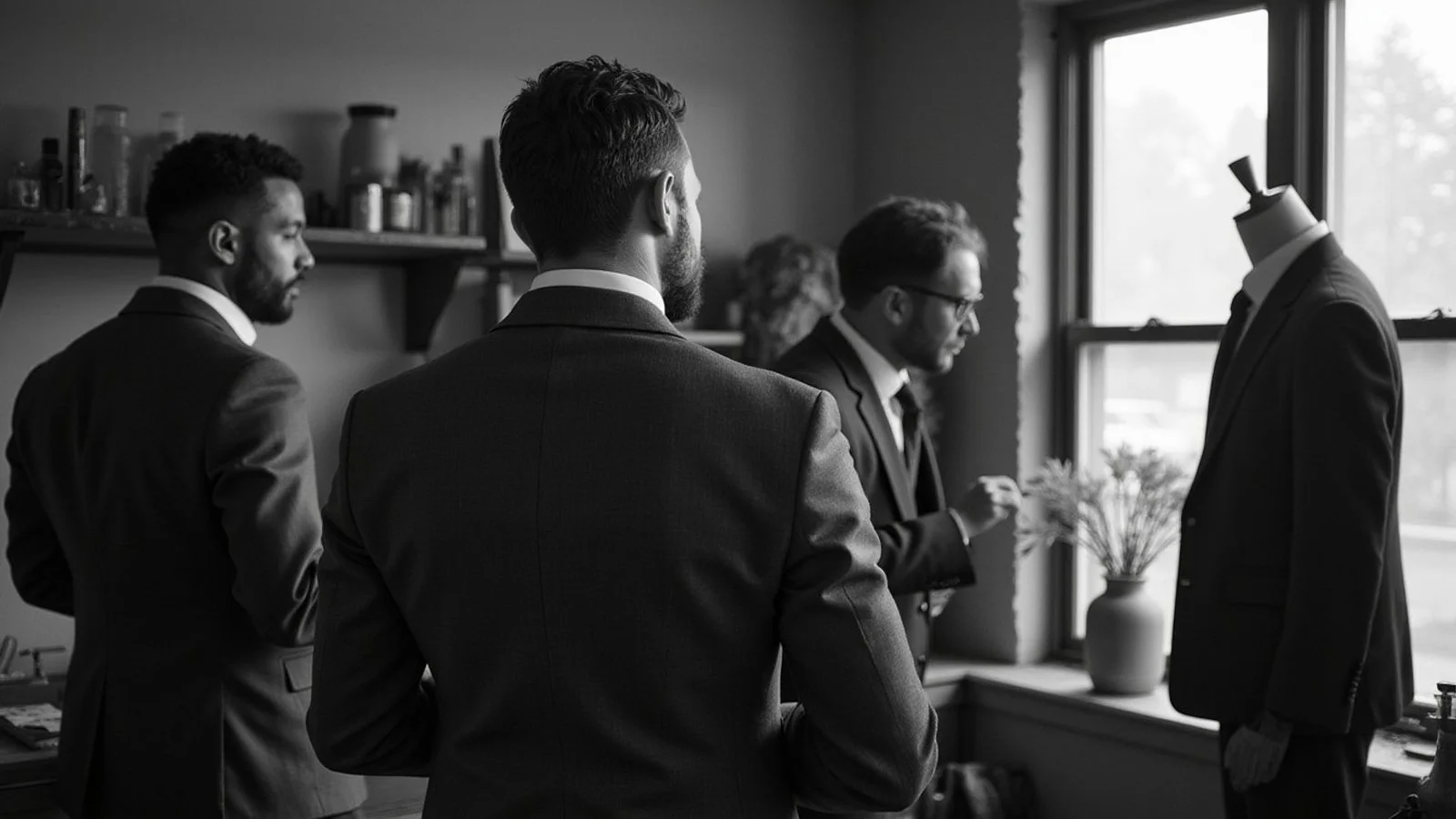
We see a lot of business owners struggle to figure out how a suit should fit.
A well-fitting garment is judged on six crucial points. If any of these details are wrong, the rest of the outfit falls apart.
Our fitting experts agree that the best cloth in the world cannot rescue a bad shoulder line.
Here is the definitive list of what to look for when shopping.
This guide explains which problems you can fix with alterations and which ones mean you need a new jacket entirely.
1. The shoulder point
We consider the shoulder point the most critical foundation of a professional silhouette.
The shoulder seam must land exactly where your shoulder bone ends. Watch out for these three common off-the-rack failures that ruin a perfect suit fit:
- The Inboard Pull: The seam sits too close to your neck.
- The Caped Drop: The seam extends past your natural shoulder.
- The Divot: The fabric collapses right below the shoulder pad.
Our team views shoulder width as the single hardest and most expensive alteration to perform.
A full shoulder reset rebuilds the jacket and often costs between $95 and $165 CAD in 2026. When a jacket misses the mark by more than half an inch, you need a different strategy.
We highly recommend commissioning [custom clothing](/bespoke-suits/) rather than pouring money into this specific adjustment.
Off-the-rack options fail the jacket shoulder fit test here more than anywhere else. Walk away from any jacket that does not sit perfectly flat across the top.
2. Sleeve length
We always check the sleeve length immediately after assessing the shoulders.
Your shirt cuff should show roughly a quarter to a half-inch beyond the jacket sleeve with your arms at rest. More than that looks sloppy in a professional setting.
Our experts notice that zero cuff visibility makes the jacket look like a borrowed rental.
Sleeve length can usually be altered quickly by a local clothing alterations shop.
Understanding Surgeon’s Cuffs
You must read the buttons before buying off the rack.
We always warn clients about functional sleeve buttonholes, also known as surgeon’s cuffs.
These working holes mean the sleeve must be shortened from the shoulder instead of the wrist. That involved alteration averages $145 to $185 CAD across Canada this year.
3. Jacket length
We use a simple method to determine the correct jacket length.
The bottom hem of the jacket should cover roughly half of your seat. Too short reads like a prep-school blazer.
Our stylists know that a coat that is too long looks heavy and dates the outfit immediately.
The Classic Fit Test: Stand naturally and curl your fingers under your hand with relaxed arms. Your fingertips should just catch the bottom edge of the jacket hem.
We find that jacket length is incredibly hard to alter down by more than a quarter-inch.
Shortening a jacket further throws off the proportions of the front pockets. This structural adjustment easily costs upwards of $125 CAD in major Canadian markets like Toronto and Vancouver.
Our best advice is to replace the jacket entirely if it is visibly too short.
You cannot fake a good structural fit.
4. Trouser break
We pay close attention to the trouser break for business attire.
The trouser hem meets the shoe at a fabric fold called a break, and a slight or medium break is right for conservative settings. You generally have three main options:
- The Full Break: Extra cloth pooling heavily on the shoe.
- The Medium Break: A professional, slight fold resting on the laces.
- No Break: The hem stops cleanly above the shoe.
Our tailors consider a full break to be completely outdated.
Having no break works on slim trousers but often looks severe in a standard boardroom context. Hem length and taper are among the easiest adjustments available.
We love recommending this specific fix because it transforms a garment instantly.
A local Victoria or Vancouver shop can taper and hem a pair of pants for just $35 to $45 CAD. See [which alterations are worth the cost](/guide/what-alterations-are-worth-the-cost/) for the decision matrix.
Our team updates this pricing data annually to help you plan your wardrobe budget.
Getting the hem right is an easy win.
5. Collar gap
We frequently diagnose collar gaps on off-the-rack suits.
The jacket collar should rest perfectly flush against your shirt collar all the way around. Any visible gap at the back of the neck is a major warning sign.
Our fitters call this the silent style killer because it ruins your profile from behind.
This space often indicates a mis-drafted pattern or a posture mismatch. Modern desk work creates a forward-leaning neck posture that standard rack blocks simply ignore.
We can sometimes fix a minor gap with a careful shoulder adjustment.
Reworking the collar stand costs around $50 to $70 CAD, but it requires an expert hand. A severe gap often highlights a core drafting problem that no alteration will fully fix.
The Profile Test: Turn sideways in a mirror with the jacket buttoned. The collar must maintain constant contact with your shirt.
Our recommendation is to perform this simple check before purchasing any new coat.
Reject the piece immediately if the collar floats away from your neck.
6. Waist suppression
We always look for proper waist suppression to finish a fitted look.
A buttoned jacket should clearly show your natural waist without looking pinched or boxy. The chest panels must curve inward to roughly two inches above the hem.
Our specialists expect a slight flare over the seat to complete a strong professional silhouette.
Proper waist suppression delivers several key benefits:
- Visual Slimming: It removes boxy, excess fabric from the midsection.
- Enhanced Shoulders: A narrower waist makes shoulders appear broader.
- Better Posture: The fitted shape encourages you to stand upright.
A jacket that already fits the shoulders can look entirely different after taking in the sides.
We typically see this high-impact adjustment priced reasonably between $35 and $75 CAD in 2026.
This structural change creates the classic V-shape that slims the wearer immediately. If only one thing is wrong with your current jacket, this is usually the best place to spend your money.
Fixable vs structural
We created this reference matrix to summarize the most common fitting challenges.
Knowing what a professional can actually fix saves you from making bad purchases. The chart below details the feasibility and average Canadian cost of each adjustment.
| Problem | Fixable? | What is involved | 2026 CA Cost Estimate |
|---|---|---|---|
| Sleeve too long | Yes | Shorten from cuff | $25 to $45 |
| Sleeve with working buttons | Yes, but costly | Shorten from shoulder | $145 to $185 |
| Trouser too long or wide | Yes | Hem and taper | $35 to $45 |
| Waist too boxy | Yes | Waist suppression, the classic alteration | $35 to $75 |
| Collar gap at back | Sometimes | Reworking the collar stand | $50 to $70+ |
| Shoulder too wide | Sometimes, costly | Full shoulder reset | $95 to $165+ |
| Shoulder too narrow | Rarely | Cannot let out beyond original seam | N/A |
| Chest too tight | Rarely | Limited material in chest panels | N/A |
| Jacket too short | No | Structurally wrong, replace | N/A |
Our team constantly references these baseline numbers when consulting with clients.
Prices vary by region, but these figures reflect current averages across major cities.
When fit points to bespoke
We advise clients to stop shopping the rack if two or more fit points are structurally wrong.
The primary issue is that your body does not map onto the block the manufacturer is scaling from. Mass-produced garments rely on standardized templates that rarely accommodate:
- Broad shoulders combined with a narrow waist.
- Forward-leaning neck posture from desk work.
- Uneven shoulder heights or arm lengths.
Our long-term solution is a [custom clothing approach](/bespoke-suits/) that addresses each of the six fit points individually.
This specific method works perfectly because the pattern is drawn directly from your own measurements. Business owners save countless hours by going this route instead of hunting for the perfect retail size.
We suggest reading [how to find a trustworthy tailor in Victoria](/guide/how-to-find-a-trustworthy-tailor-in-victoria/) for a broader view on choosing a local professional.
Minor issues are a completely different story. For off-the-rack pieces that fail on only one or two small points, the right answer is often an [alterations](/alterations/) appointment.
Our final piece of advice is to always ask for an honest quote before starting work.
A professional shop will tell you exactly when an adjustment is worth the money and when you should walk away. Schedule a fitting with us today and use this suit fit guide to ensure your wardrobe makes the right impression.
Common questions
Is a tight or loose shoulder fixable by alterations?
+
Shoulder width is the hardest alteration — it usually requires rebuilding the jacket from scratch at close to the cost of bespoke. A shoulder that misses by more than half an inch is typically a signal to commission bespoke rather than alter.
How much cuff should show beyond the jacket sleeve?
+
Quarter to half an inch of shirt cuff with your arms at rest. More than that reads sloppy; none at all reads like the jacket sleeve is too long.
What is a 'trouser break' and which break suits a business suit?
+
The fold at the shoe where the trouser hem meets the instep. A slight or medium break reads conservative and works for court, business, and formal events. A full break is dated; no break is fashion-forward and best avoided for traditional settings.
More from this cluster
Caring for Your Custom-Tailored Garments
How to press, brush, rotate, and store a bespoke suit so it lasts ten years. Dry cleaning frequency, hanger choice, and stain handling.
Decision stageHow to Find a Trustworthy Tailor in Victoria, BC
Questions to ask, red flags to watch for, and how to tell a real tailor from a retail alteration counter in Victoria BC.
InformationalThe Savile Row Method: Training, Tools, and Why It Matters
What Savile Row training really involves, how it differs from made-to-measure, and why it changes how a bespoke suit is drafted in Victoria BC.
Questions beyond what's here?
Free thirty-minute consultations on Fort Street. We'll answer your specific questions and give you a realistic quote.