How to Choose a Trustworthy Alterations Tailor
What separates a trained tailor from a retail counter, how to spot outsourced work, and why on-site workshops actually matter for accountability.

We constantly see the fallout from poorly executed clothing adjustments right here in our Victoria, BC workshop. The global alteration market is booming and is expected to reach $10.3 billion in 2026.
Learning how to find a good alterations tailor is the only way to protect your wardrobe. Our team knows that high-volume retail counters look identical to traditional shops from the street, but they operate on a completely different business model.
This clear distinction separates the professionals from the outsourced shipping operations.
We are going to walk you through the visual cues and specific questions you need to spot an authentic, in-house setup. You will learn how to identify exactly where your clothing goes after you hand it over.
The fast-screen checklist: how to find a good alterations tailor
You can identify a reliable shop by asking four specific questions about their workflow and location. These questions reveal exactly where your garment goes after you drop it off.
We suggest keeping this checklist handy for your next visit. Retail chains often partner with third-party logistics services, like SOJO, to handle off-site repairs.
Our experience shows that clear answers to these four questions will save you significant time and money.
Four questions you can ask on first contact:
- “Is my garment altered on-site, or sent out?”
- On-site: “Yes, by [tailor name] in our Fort Street workshop.” ✓
- Not on-site: “We work with a partner” or “Sent out to our warehouse.” This indicates a courier shipping model.
- “Can I see the workshop?”
- Welcomed: “Of course, it is right through here.” ✓
- Deflected: “It is in the back” or “Customers are not allowed in the back.” Deflection usually means the physical workshop does not exist on the premises.
- “Who specifically does the alteration?”
- A named person. ✓
- “Our team” with no specifics. A vague answer often points to a rotating roster of outsourced, piece-rate workers.
- “Do you ever turn away work?”
- “Yes, when an alteration will not meaningfully improve the garment.” ✓
- “We take everything.” A volume shop has no quality filter and prioritizes taking your deposit.
Trained tailor vs retail alteration counter
A trained in-house tailor handles your garment from pinning to the final stitch inside their own workspace. A retail counter simply acts as a middleman, collecting items to ship to a distant facility.
We know that a standard pants hem requires about 1 to 5 business days when done correctly in a local shop. Outsourced depots often enforce a rigid 14-day cycle just to account for transit times. Our clients notice immediate physical differences between these two setups upon walking through the door.
| Trained tailor | Retail counter |
|---|---|
| Cutting table visible | No visible workspace |
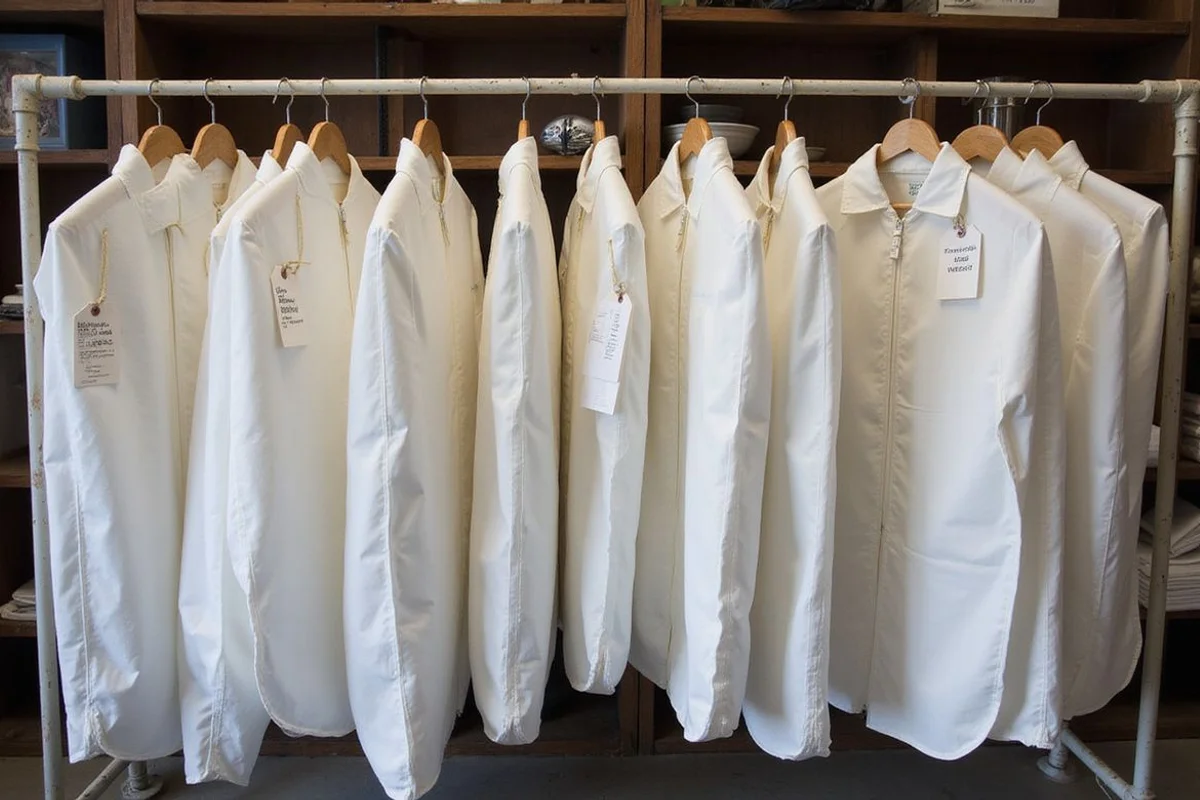
| Garments on labelled hanging rail | Garments in plastic bags with stapled tickets |
| Fittings in front of a mirror | Fittings at a raised counter |
| 15 to 30 minutes per fitting | 2 to 5 minutes per fitting |
| Pinning done by the tailor | Pinning done by a front desk clerk |
| Quote given after fitting | Flat laminated price list |
| Honest “this will not work" | "We can do anything” |
Neither option is wrong for every job, as a simple pants hem does not always need the full workshop treatment. We recognize that for anything involving a jacket, a wedding dress, or a multi-fitting alteration, the trained in-house model produces substantially better results.
A 2025 industry survey showed that 97% of mass-market clothing brands outsource production, and many retail alteration chains simply copy this low-margin strategy.
Why on-site actually matters
Keeping the work on-site eliminates shipping risks and allows the professional to adapt if the internal structure of the garment is complex. Three practical reasons explain why this physical proximity protects your clothing investment.
1. Accountability
If an alteration goes wrong, the person who did the work is present. They can re-do it, adjust it, or walk you through why the result is what it is.
A sent-out alteration that comes back wrong has to ship back, queue for a re-do, and ship back again. This process often causes a two-week delay and comes with a very ambiguous explanation.
We have seen rush fees at outside counters range from a 25% to 100% markup just to fix their own scheduling errors. An in-house operator fixes the issue immediately without penalizing your wallet.
2. Scope adjustment
Many alterations look simple during the quote and turn out to be much more complex once the garment is open. An on-site tailor can pause the work, call you, and discuss scope changes.
We frequently see situations where taking a garment down by four sizes requires taking the item apart completely to sew a whole new pair. A sent-out operation just ships the result back and asks you to accept the poor fit or pay a second time to re-do it.
3. Garment tracking
Sent-out alterations travel by courier. Each courier handoff is a small tracking risk. We have met clients over the years who lost a wedding dress or a vintage heirloom in a multi-hop courier chain.
On-site tailors cannot lose a garment because the item never leaves the shop. Bridal alterations alone take two to three months and require three separate fittings.
Shipping a valuable dress back and forth introduces severe risks:
- Packages delayed at sorting facilities
- Items damaged by weather during transit
- Garments returned to the wrong retail counter
- Total loss of irreplaceable heirloom pieces
We know that keeping your item in one building eliminates these tracking nightmares entirely.
How to spot outsourced work
You can spot an outsourced operation by watching their intake process and checking their promised turnaround times. Even shops that do not openly describe themselves as outsourcing have clear telltales.
We advise looking for these five common warning signs:
- Turnaround longer than the work would suggest. A hem that takes two weeks when the workshop is empty is usually sitting on a delivery truck.
- No fitting offered. The “Drop off, come back” phrase is a massive volume-shop indicator. Proper alterations involve physical fittings.
- Fittings always with staff, never a tailor. Volume counters use a sales and intake team, while a trained professional will be completely absent from the floor.
- Vague pricing. A staff member quoting sight-unseen from a laminated card is selling a fixed, inflexible product.
- No ability to talk to the person doing the work. Hearing “I will pass your request along” means the person altering the garment is located miles away.
Honest-advice policy as a signal
A quality tailor prioritizes the integrity of your clothing over making a quick sale. Providing trustworthy tailor alterations means turning down a project if the cost outweighs the benefit to the garment.
We recognize that sustainable fashion is a major driver in today’s market, and extending a garment’s lifecycle requires honest assessment. A tailor who takes every job is optimizing for volume instead of quality.
We explicitly decline work when:
- Alterations will not meaningfully improve a garment.
- The cost would exceed 25% of a new equivalent and the fit gain would be minor.
- The fabric is too fragile to safely alter.
- The requested alteration is physically impossible given the seam allowances.
Clients occasionally find this frustrating in the moment, but they nearly always appreciate the honesty in hindsight. Our goal is to protect your wardrobe, not drain your wallet. Building a long-term relationship depends on this exact kind of transparency.
What a good first interaction looks like
A professional interaction involves a proper fitting, clear communication about the internal structure of the garment, and a transparent timeline. This baseline level of service ensures your clothing is in safe hands.
You can walk-in or call-ahead to start the process. A tailor greets you, looks at the garment, and has you put it on.
Expect about fifteen minutes of pinning, discussion, and scope clarification. We ensure you receive a quote at the end, cleanly written on the ticket.
A realistic turnaround date is provided, such as one to two weeks for a suit jacket sleeve adjustment.
A firm handshake closes the deal. If the first interaction feels like that, you have likely found the best alterations tailor Victoria has to offer for your specific needs.
Learning how to find a good alterations tailor ends here. For booking, see our alterations service.
For the “is it worth it?” question see what alterations are worth the cost.
Common questions
How can I confirm my alteration is being done on-site?
+
Ask to see the workshop or ask who specifically will be doing the work and when. A direct answer with a name and timing is the baseline. Hedging, 'our partners,' or 'we send it out' means the garment leaves the shop — which means tracking risk.
What's a red flag in alteration pricing?
+
A flat price with no mention of what's included. Proper work is quoted after the fitting — scope can change based on construction details we can only see once the garment is on the body. A flat price quoted sight-unseen usually hides either an underpriced simple case or an undiscussed premium case.
Why do retail counters lose garments?
+
They ship to remote workshops, which introduces tracking risk across courier systems. On-site tailors don't lose garments because the garment never leaves the shop.
More from this cluster
Alterations Cost in British Columbia
BC-wide alteration pricing: suit $75–$300, dress $50–$250, hems $20–$35. What drives cost, why on-site beats outsourced, Vancouver comparisons.
InformationalAltering Vintage and Heirloom Suits
What's possible with vintage full canvas, invisible darning on moth damage, respectful restoration, and when a piece is better left untouched.
Decision stageAltering vs Buying New: When Is Each Right?
A decision matrix for when alterations extend a quality garment vs when buying new is better value. Honest advice, not a sales pitch.
InformationalHow Long Do Suit and Dress Alterations Take?
Standard 1–2 weeks explained. When multiple fittings are needed, rush service options, and how to time alterations around weddings and court dates.
Questions beyond what's here?
Free thirty-minute consultations on Fort Street. We'll answer your specific questions and give you a realistic quote.