Custom Shirt vs Off-the-Rack: When to Upgrade
A decision-stage guide for Victoria business buyers: the three fit signals that justify upgrading from rack to custom, where rack still works, and what changes when you cross over.

We see the same pattern at the workshop most weeks.
A business owner walks in with an untucked rack shirt under a blazer. The cloth bunches at the waist, the collar sits a half-size off, and the cuff hides under the watch. We know exactly what causes this common frustration.
The real question is not whether custom would fit better, but whether the upgrade makes financial sense for your specific wardrobe. Let’s compare custom shirt vs off-the-rack options, look at the data behind clothing lifespan, and figure out the smartest move for your weekly rotation.
When custom shirts start earning their price
Custom shirts start earning their price the moment your daily off-the-rack rotation requires constant alterations or fails basic fit tests. If your dress shirts already fit your neck, sleeves, and waist with no pulling or bunching, off-the-rack is fine. We recommend observing your clothing lifespan carefully.
The Dry-Cleaning and Laundry Institute reports that a typical dress shirt lasts about 35 to 50 wash cycles. This equates to roughly two years of regular wear. We notice that poorly fitting shirts wear out much faster due to fabric strain and excess friction.
The upgrade pays off once two of three signals show up in your daily rotation. You might see a collar that gaps when fully buttoned, sleeves that land on the wrong part of the hand, or extra waist cloth that pillows under a jacket. Our matrix below helps sort your shirts into rack, repair, or replace.
The three fit failures that signal an upgrade
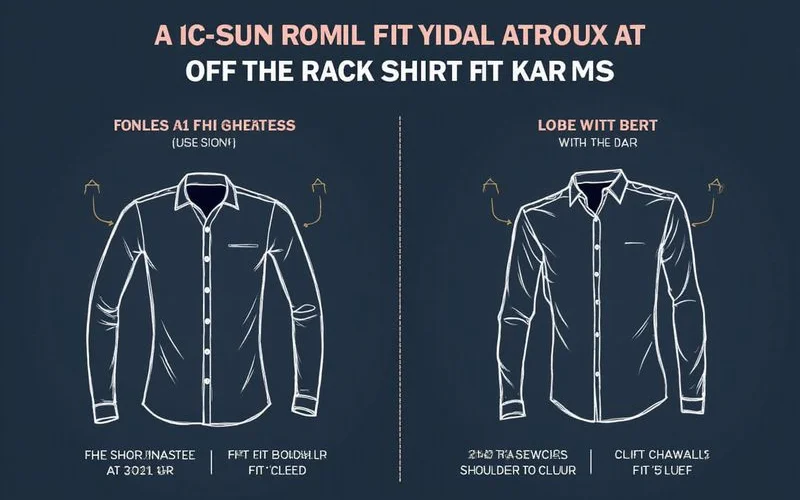
The top three fit failures that signal an upgrade are a gapping collar, an incorrect sleeve length, and excess fabric pooling at the waist. Most rack shirts get sized by the neck, then everything else scales from a single block. We see trouble start when one dimension drifts and the rest follow.
That works if your body exactly matches the block. Watch for these three failures:
- Collar gap under a tie. Our clients often fail the standard two-finger rule test. The neck closes but the points lift away from the shirt body. You should only be able to slip your index and middle finger comfortably between your neck and the buttoned collar. We consider a shirt too large if three fingers fit easily, creating a gap that a jacket lapel will frame rather than hide.
- Sleeve landing in the wrong place. A correct cuff sits at the base of the thumb with a quarter inch of shirt below the jacket sleeve. Anything past the first knuckle is too long. Our team frequently sees sleeves landing in the wrong place entirely.
- Waist cloth bunching under a blazer. Excess fabric folds into a roll above the trouser waistband. It reads as untidy in every meeting photo. We identify this waist cloth bunching as the final major signal.
One of these by itself is not a strong upgrade signal. Two or three at once usually means your body has drifted from the rack block, and no amount of brand swapping will fix it.
A decision matrix for your dress shirt rotation
We designed a clear decision matrix to help you assess your current dress shirt rotation and decide between buying off-the-rack, altering, or upgrading to custom. The table below sorts the most common situations Victoria clients arrive with. Triage your closet using this guide before booking anything.
| Your situation | Smart move |
|---|---|
| Standard build, casual wardrobe under a sport coat once a week | Stay with rack, hem sleeves if needed |
| Standard build, daily business wear under a blazer | Try one custom for the rotation centrepiece |
| Asymmetric shoulders, hard-to-fit chest or yoke | Move to custom, rack will keep failing |
| Neck and sleeve never agree on the same size | Move to custom, this is the classic block mismatch |
| Bought premium rack and still gaps at the collar | Custom, you have already proven brand is not the variable |
| Wedding party shirts for a single event | Rack with light alterations is usually enough |
| Building a long-term professional wardrobe | Start one custom this season, build to three or four |
Our visual comparison of where the fit usually breaks helps make the call quicker.
What you keep paying for if you stay with rack
Sticking with off-the-rack shirts means you keep paying for hidden alteration fees, early replacements, and constant brand swapping. Quality rack shirts in Canada sit between $80 and $150. We hear about these hidden costs every single week.
They feel cheaper at the till and more expensive over a year of wear. The most common issues are the exact same ones that nudge clients into a first commission.
- Hunting for a brand. Our first hidden cost is repeated returns and exchanges in the first month while you hunt for a brand that nearly fits.
- Light alterations on each new shirt. Adjusting the chest and waist at a Canadian alteration shop typically costs between $40 and $53 per shirt. Hemming sleeves adds another $25. We note that these light adjustments still cannot touch the collar or the yoke.
- Replacing worn shirts. Mass-produced fast fashion shirts often fail in under a year. Replacing shirts every twelve to eighteen months hurts the wallet as collars wilt and seams pull. Our clients also mention photos and meeting moments where the shirt undermines the rest of the outfit.
None of these are catastrophic on their own. They quietly add up to a dressing routine that never quite looks right.
Where rack shirts still hold their own
We do not push every client into custom. Rack shirts still hold their own for standard builds, casual weekends, and strict budget limits under $100. They make sense in three common situations:
- You have a standard build with no real fit complaints. A 16-inch neck with a matching 33-inch sleeve and a regular drop waist is well served by mainstream brands. Your body naturally matches the standard factory dimensions. We recommend sticking with off-the-rack if this describes you perfectly.
- Your shirts live mostly off-camera. Casual garments rarely see a boardroom environment. The weekend Oxford under a sweater does not need precision fitting. Our clients save their custom budget for high-stakes meetings instead.
- Your budget for shirts is firmly under $100 each. Custom options start higher, usually around $195 for an entry shirt. Budget restrictions mean a careful rack purchase is the honest answer. We respect financial boundaries and will always advise the smartest purchase for your current situation.
Hold on the upgrade if two of those three describe your wardrobe. Save it for the year your role, body, or daily uniform changes. Our team suggests reviewing your options again when you get a promotion or shift to a more formal office environment.
What changes when you cross to custom
Our precise digital patterns make future ordering incredibly fast and reliable when you cross to custom. The daily routine shifts in small ways that compound once a pattern exists for your body. Entry custom shirts run $195, the premium tier is $275, and flagship cloths reach $350.
We see several major shifts in the process after that first successful fit:
- Zero drafting time. Eliminating drafting time happens instantly for repeat orders off the same draft. Repeat purchases ship on a much faster timeline. Our production team saves your exact block for immediate use.
- Premium material longevity. High-quality two-ply cotton fabrics, like Egyptian or Pima, extend the garment’s life significantly. These materials resist pilling and hold their shape wash after wash. We source these durable cloths specifically for daily professional wear.
- Saved style preferences. Future orders do not require you to remember every little detail. The next shirt picks up exactly where the last left off. Our records keep track of your fabric, stitch, and finishing choices automatically.
That companion piece below walks through the seven body dimensions recorded and why each one matters. Read the full mechanical breakdown of what custom measurement captures for more details. We outline all dollar figures across tiers and add-ons in the BC custom shirt pricing guide.
How to test the upgrade without overcommitting
Testing the upgrade is easy by ordering a single, highly versatile shirt color to wear for a full week. Most first-time custom buyers do not need to convert their whole rotation in one go. Our team tells new clients to try a single crisp white or light blue daily shirt first.
These two options are the most versatile colors for Canadian business wear. Wear your new trial shirt under a jacket for a full work week. We suggest paying close attention to these specific comfort points:
- Collar stability. Notice how the collar holds its shape without choking you during afternoon meetings.
- Waistline neatness. The fabric should stay flat against your stomach when you sit down.
- Sleeve positioning. Our trial method confirms the cuffs stay at the base of your thumb when you type.
Order two more off the same pattern and retire the worst rack shirts in your closet if the difference is hard to ignore. Step back to rack with confidence if the difference feels subtle, because your body and your rack brand were already a good match. We find that asking yourself when to upgrade to custom shirts becomes easy once you feel the fabric difference firsthand.
Picking your first custom shirt with confidence
Picking your first custom shirt starts with a simple conversation about your weekly schedule and a review of your current favorite shirts. A useful first consultation focuses on how often the shirt will be worn and what fails on the rack shirts you already own. We ask that you bring one shirt that fits well and one that does not.
The tailor will measure both, draft a starting pattern, and quote cloth options that match your week. No commitment is required after the consultation, and you walk out with a clear answer. We designed the process to be completely transparent.
Taking this step is the best way to answer the final question: is a custom shirt worth it? Review your closet this weekend and pull out your most frustrating shirts. Our scheduling tool makes it simple to start with our custom shirts service when you are ready to book your fitting.
Common questions
Is one custom shirt enough, or do I need to commit to a rotation?
+
One is enough to test whether the fit difference matters to you. Most clients order one as a trial, then use the pattern on file to add two or three more over the following year. You do not need to replace your rack shirts overnight.
What if my body shape might change in the next year?
+
Tell us at the consultation. We adjust the pattern on a future order without redrafting from scratch, as long as the change is within a reasonable range. Patterns are kept on file specifically so they evolve with you rather than being thrown out.
Can a tailor fix a rack shirt instead of replacing it?
+
Sometimes. We can take in the waist, shorten sleeves, or move buttons. We cannot meaningfully reshape the collar, the yoke, or the chest block. If your fit problems are at those structural points, alterations will not solve them.
More from this cluster
Custom Shirt Cost in British Columbia
BC custom shirt pricing: $195 entry, $350 flagship. What drives cost — fabric tier, monogram, buttons — and how pattern-on-file makes repeats economical.
InformationalHow Long Does a Custom Shirt Take?
Three to four weeks for a first shirt, 10–14 days for repeats off your pattern. Exact breakdown of measurement, drafting, cutting, and construction.
Decision stageChoosing Fabric for Custom Shirts: Thomas Mason vs Albini
Thomas Mason's English heritage vs Albini's Italian softness — weave types, two-ply vs single-ply, and matching fabric to wear occasion.
InformationalWhat Makes a Custom Shirt Different from Off-the-Rack?
Where off-the-rack shirts fail (neck vs sleeve, collar gap, waist), what custom measurement captures, and how pattern files speed repeat orders.
Questions beyond what's here?
Free thirty-minute consultations on Fort Street. We'll answer your specific questions and give you a realistic quote.